An evening of the ACADEMIYON Cultural Platform (Saria: Automated Analysis of Retinal Images)
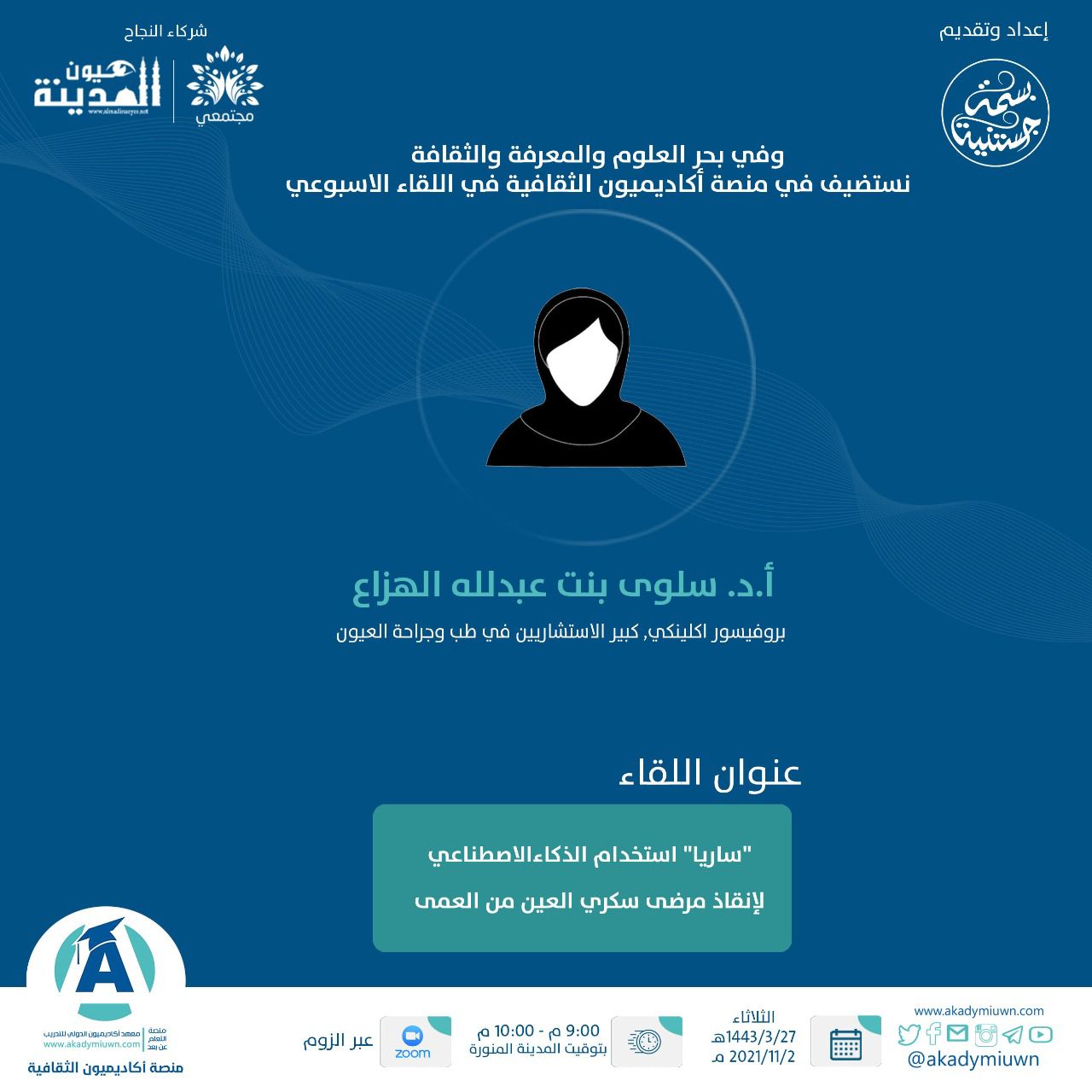
The ACADEMIYON Cultural Platform launches a non-profit platform that is concerned with disseminating knowledge and sciences through ambassadors, members, and advisors of the institute, and through a variety of readable, audible, and visual materials, weekly evenings every Tuesday evening to highlight topics of interest to contemporary society in all fields. The evenings feature a distinguished elite of intellectuals and pioneers of science in various fields, and this Tuesday's evening, 27/3/1443 AH corresponding to 2/11/2021 AD, is titled ("Saria" Using Artificial Intelligence to Save Diabetic Eye Patients from Blindness) presented by Professor Dr. Salwa bint Abdullah Al-Hazza, a clinical professor and senior consultant in ophthalmology, nicknamed "Doctor of Kings" and "Doctor of the Five Continents." The evening began at 9 PM on Zoom, and the evening was presented by Dr. Sonia Malaki.
Dr. Al-Hazza began the evening by clarifying that Saudi Arabia leads the G20 countries in the 2021 Digital Competitiveness Report, and that artificial intelligence will transform the digital health industry into an innovative, effective, sustainable health system available to all diabetic patients. This achievement stems from the support, empowerment, and funding for the information and communications technology sector over the past years, and reflects the qualitative leaps that the Kingdom has achieved in the information and communications technology infrastructure, developing digital capabilities, and massive digital projects as a result of the 2023 Information and Communications Technology Sector Strategy derived from the Kingdom's Vision 2030 "Health and Well-being." She clarified that Saria is an approved technology that uses artificial intelligence to examine diabetic retinopathy, which is one of the serious complications resulting from diabetes, and has proven speed, safety, accuracy, and consistency with ease of use. The Saria system provides results within minutes, offering immediate examinations for diabetic patients in their area.
Dr. Al-Hazza pointed out that artificial intelligence is the new buzzword in ophthalmology, transforming the traditional health system into a digital one. The presence of artificial intelligence is to empower and support natural human intelligence and its tasks, created to simplify daily health activities. Moreover, artificial intelligence and digitization are absolute health necessities and fuel for the economy. The United Kingdom is at the forefront of using artificial intelligence within the "Eye Health System," and Saria currently focuses on diabetic eye patients.
Dr. Al-Hazza confirmed that one in three diabetic patients is at risk of developing diabetic eye disease, with an estimated "463" million diabetic patients worldwide, and all diabetic patients need eye examinations. This number is expected to rise to "578" million by 2030, representing a 51% increase. Only 24% are examined in Saudi Arabia, and automation is the only way to examine the rapidly growing population. Therefore, automation is necessary; unfortunately, the old method uses intensive human resources, long patient wait times, and high costs. To obtain high-quality examinations, the patient must be present in the hospital.
Dr. Al-Hazza clarified that there is a vast difference between telemedicine and artificial intelligence; telemedicine is considered traditional, using human facilitators remotely, which is costly and delays results. In contrast, artificial intelligence examines the patient in their location and provides immediate results while the patient is still in the imaging room. It also increases efficiency and productivity, saves time, and wisely utilizes the skills of eye consultants to enhance their surgical expertise, while reducing unnecessary resources for the institution and providing care in an accessible manner at low prices, aiming for the comfort of the patient and service providers.
Dr. Al-Hazza highlighted what distinguishes the Saria system, as it is used on five continents, utilized on 500,000 patients, and over two million retinal images. Saudi Arabia is interested in the Saria system because it has seven million diabetic patients, working to reach this program to every diabetic patient in Saudi Arabia. She also explained the mechanism of using the system, its features, and opportunities in customer subscriptions, adding: "In the coming years, we look forward to placing the system on mobile devices so that the patient does not need to go to the diabetes center or primary clinics, but can access it from home at any time." Dr. Al-Hazza presented the conclusions, then thanked all the members of the platform and those in charge of it, and added: "My dream is to reach every diabetic patient in remote areas who do not have the means to visit major cities for treatment."