An evening of the ACADEMIYON Cultural Platform (Practices that Lead Leaders to Leadership)
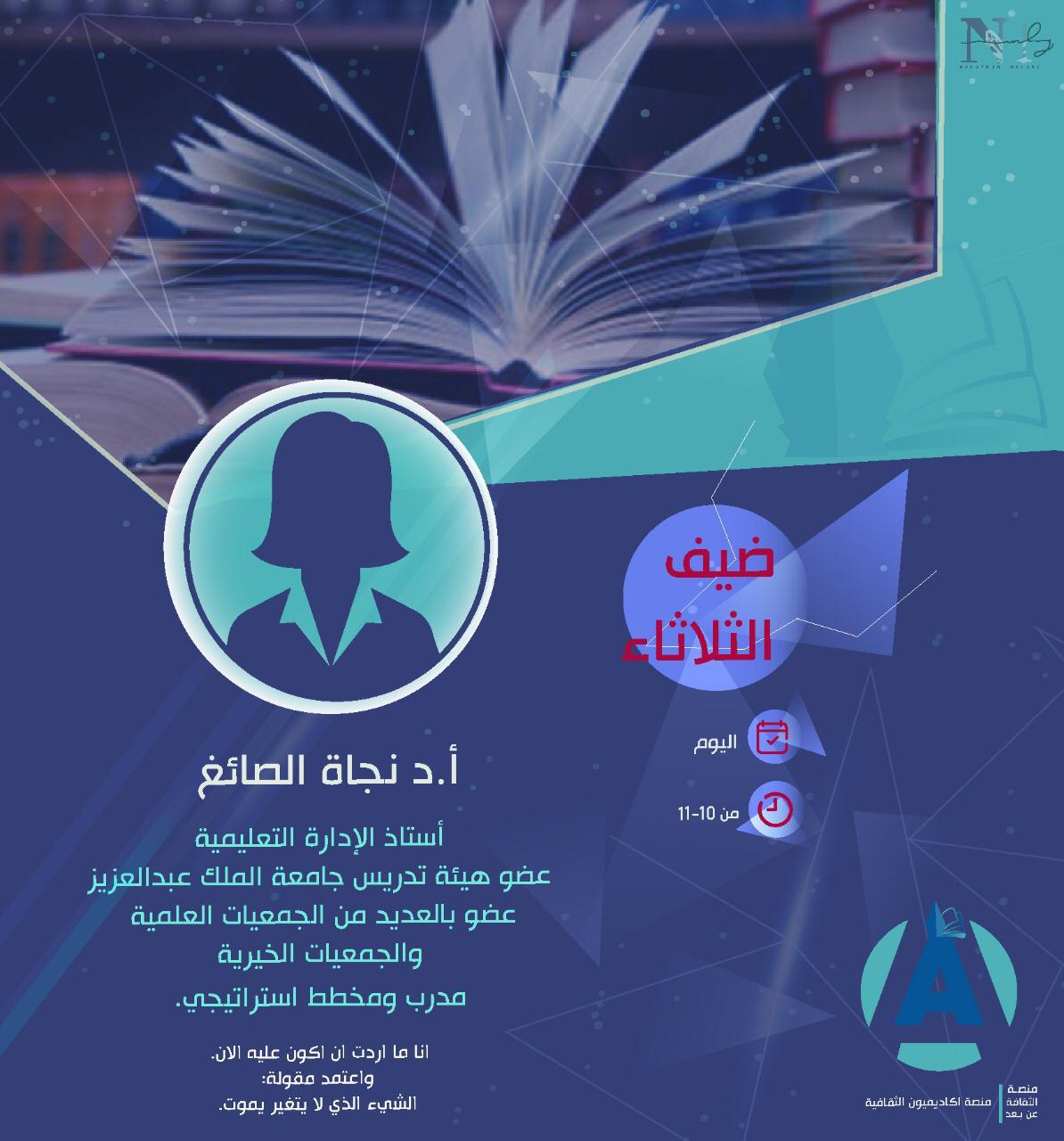
The non-profit ACADEMION Cultural Platform has worked to attract a distinguished elite of experienced figures in various scientific and literary fields todisseminate knowledge and sciences through the ambassadors and advisors of the institute. The platform also broadcasts a series of interactive weekly meetings that shed light on many important points in various fields, and the platform presented on Tuesday, corresponding to 3/12/1442 AH, an evening titled (Practices that Lead Leaders to Leadership) in light of the personal experiences of Dr. Najat Mohammed Al-Sayegh, Professor of Educational Administration and faculty member at King Abdulaziz University, and a member of many scientific and charitable associations, as well as a trainer and strategic planner. The evening began at ten o'clock in the evening via WhatsApp, and the guest of the evening was introduced by Dr. Mishal Al-Mahlawi.
Dr. Al-Sayegh began the evening by appreciating the people of virtue and value in the scientific movement, and those striving to raise the ceiling of knowledge exchange among specialists in diverse fields to stimulate ideas and expand circles of knowledge, represented in the esteemed professor Mishal bin Yaseen Al-Mahlawi, founder of the ACADEMION International Training Institute from which the ACADEMION Cultural Platform emanates.
Dr. Al-Sayegh indicated that she chose in this evening to address some practices that lead leaders to leadership due to her specialization in administration, and the results of experiences and scientific research that she has diligently engaged in and applied when given the opportunity, as she mentioned those practices she applied in her leadership, including: role modeling, shared vision, challenge, empowerment, motivation, knowledge building, delegation, and human relations, and these practices helped her attract those around her effectively.
Dr. Al-Sayegh raised a question about the reasons for implementing those practices? She clarified that these practices occur within various institutions, whether educational, profit-making, or others; to achieve the organization's goals and personal objectives, to keep pace with surrounding changes and utilize them to serve the organization, as well as to motivate individuals and develop their capabilities and enhance their human and practical skills to benefit from them in achieving the organization's goals.
Then Dr. Al-Sayegh explained how to apply those practices, as any work to be serious and convincing to followers must define elements based on the components of the organization, and the elements of the organization consist of: inputs, processes, and outputs, and through these elements, leaders should apply certain practices that lead them to leadership in management, as Dr. explained (Practices that Lead Leaders to Leadership) through the three elements of the organization and reviewing those practices and applying the elements to them.
Dr. Al-Sayegh concluded her speech by saying: "I have reached the eight practices after serving twenty years as a leader or manager in educational institutions, and I have conducted many studies and research on them; to confirm that these practices are what a leader can use to achieve the institution's goals and his personal objectives, when the leader sees that the success of the institution is his personal success, he will inevitably be able to succeed the institution, for I see that the role is more important than the job, as the job ends while the role in this job is what remains and endures, and all the people who were among them remember me for those roles, and if the leader or manager can deal with those practices, he will gain what he aspires to and achieve the institution's goals and his own, as I have gained through my leadership experience administrative maturity, wisdom, and acumen that I can use to deal with various situations, and I have gained from real-world experience and by keeping up with what is new in writing about leadership and applying some surveys to measure employee opinions in the scientific research I conducted until I developed my own vision and principles in administrative work through which I can evaluate the performance of any institution and identify its shortcomings."
Some members of the ACADEMION Cultural Platform presented their interventions and questions to Dr. Najat Al-Sayegh, including: Dr. Mohammed Ilyas from Islamabad, Dr. Mohammed Al-Sharif, Dr. Mona Ramadan Al-Shazly, and Professor Asia Yarkandi, and Dr. Mishal Al-Hanawi concluded the evening by saying: The responsibility remains on us in the matter of implementation and moving from pathways and experiences to the realm of reality, and I thank the esteemed Professor Najat Al-Sayegh, who is skilled in the art of management, and I ask Allah Almighty to make us among those who fulfill the saying of the Prophet, peace be upon him: "The angels lower their wings for the seeker of knowledge, pleased with what he does.".