Analytical reading of the decisions of the Modern Universities Council
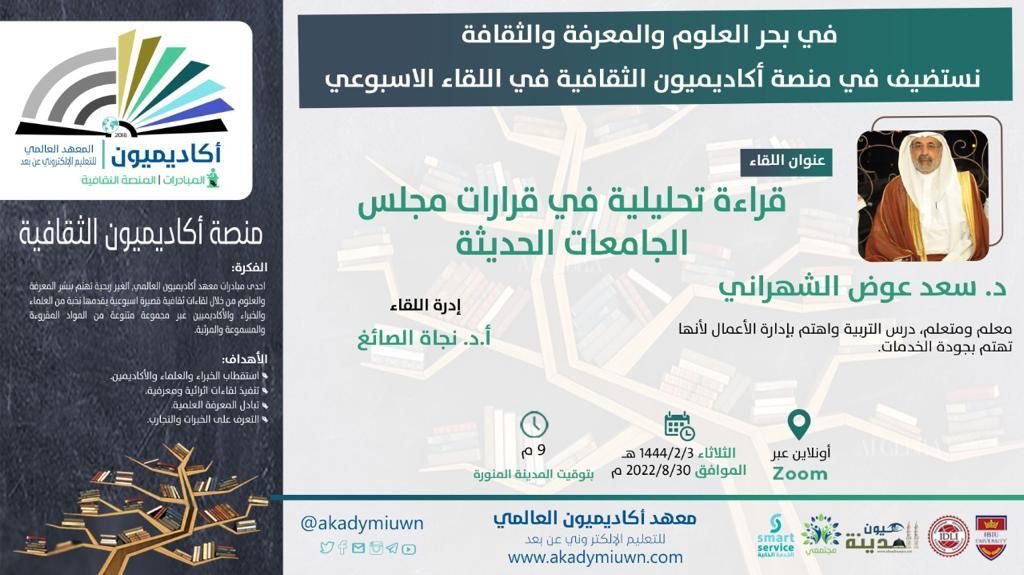
As part of the series of meetings presented by the ACADEMION Institute through the ACADEMION Cultural Platform, a non-profit platform dedicated to disseminating knowledge and sciences through the institute's ambassadors and advisors, and through a variety of reading, audio, and visual materials, the platform held the weekly meeting on Tuesday, 30/8/2022, corresponding to 3/2/1444 AH, titled "An Analytical Reading of the Decisions of the Modern Universities Council" in which His Excellency Dr. Saad Awad Al-Shahrani was hosted, and the meeting was moderated by Her Excellency Professor Dr. Najat Al-Saigh, via the program. ZOOM.
Dr. Al-Shahrani began his talk about the main features of the modern system project in universities, mentioning that it includes (58) articles that will achieve many benefits for universities and will free them from the bureaucratic procedures that hinder their progress towards developing the educational and research process and enhancing their financial resources.
Dr. Al-Shahrani also clarified that one of the main features of the system project is achieving independence so that universities have an independent personality according to public policies, and to align structurally and organizationally with Vision 2030, as well as to approve their specializations and programs according to developmental needs and job opportunities in the region they serve, in addition to reducing operational costs by seeking funding sources and minimizing reliance on the state, and approving the budget of each university through an innovative funding system, then separating other items and clarifying what is included in them regarding systems and updates.
Dr. Al-Shahrani explained the regulatory provisions in universities, where universities that will apply the system project will initially be granted a transitional period of "one year" from the date of the system's implementation, and the Universities Affairs Council may extend the transitional period for some of those universities, not to exceed 3 years.
Dr. Al-Shahrani referred to the components of the university system, which consists of colleges, deanships, scientific departments, institutes, centers, and educational units below the university level, as well as university hospitals, and he also mentioned the members of the Universities Affairs Council, their selection criteria, and their advantages.
Dr. Al-Shahrani reviewed the competencies of the university council regarding proposals and cooperation agreements, executive regulations for academic regulations, and the rules governing the delegation of powers in various councils within the university, the appointment of faculty members, and so on regarding granting academic degrees to graduates, establishing medical chairs and setting their regulations, as well as how to select the Secretary-General of the university council and the powers of the university president.
Dr. Al-Shahrani explained the advantages of the position of university president, the mechanism for appointing vice presidents of the university, and advisory councils, and he clarified the financial system of the university, the university endowments, and touched on the components of the university's revenues, and the university branches which consist of 30 branches, and it is permissible by a decision from the Council of Ministers based on a proposal from the Board of Trustees and the approval of the Universities Affairs Council to establish branches of universities outside the Kingdom.