
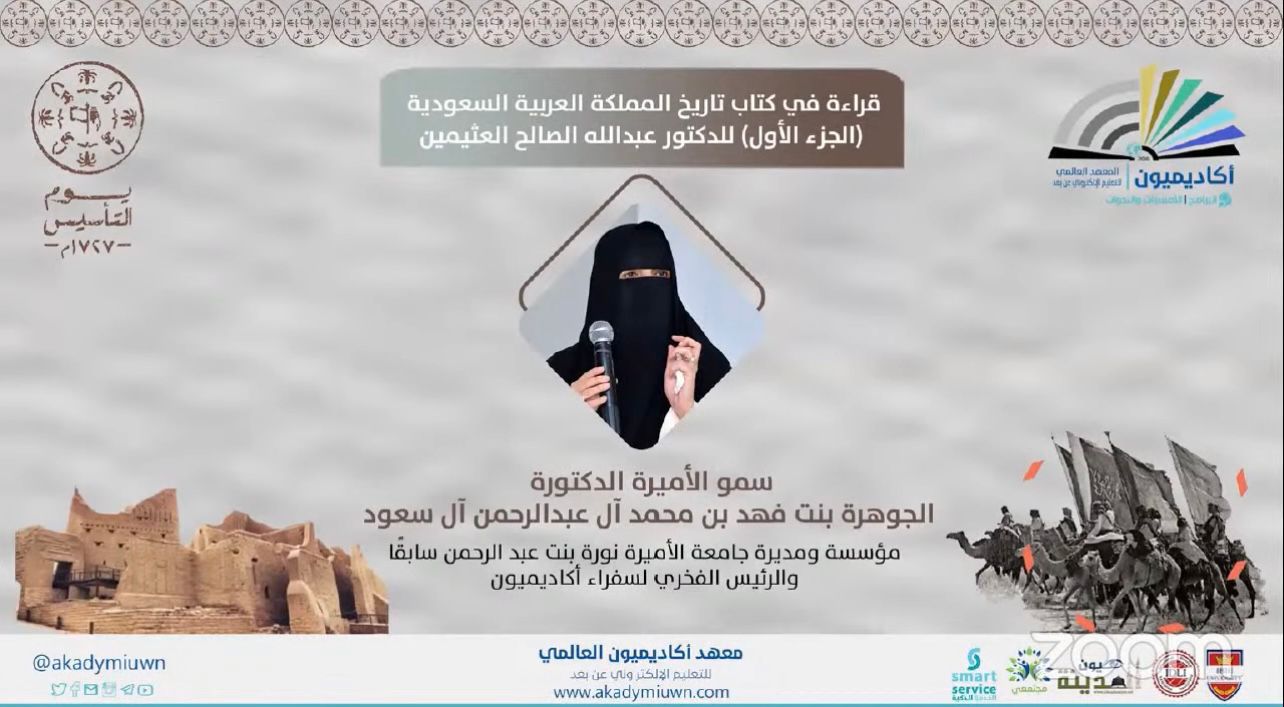
Founding Day of ACADEMION International Institute: A Reading of the Book (History of the Kingdom of Saudi Arabia)
The ACADEMION Cultural Platform, the non-profit platform dedicated to disseminating knowledge and sciences through ambassadors, members, and advisors of the institute, organized a meeting on the occasion of Foundation Day with Her Highness Princess Dr.: Al-Jawhara bint Fahd bin Muhammad Al-Abdulrahman Al Saud, PhD in Arabic Language Sciences specializing in grammar and morphology, founder and director of Princess Nourah bint Abdulrahman University, assistant vice president for educational affairs, dean of the College of Education for Girls in Riyadh, member of the International Federation of the Arabic Language, and honorary president of ACADEMION ambassadors. The meeting featured a reading of the book History of the Kingdom of Saudi Arabia "Part One" by Dr. Abdullah Al-Salih Al-Othaymeen, and took place on Sunday, February 27, at 9 PM via Zoom, moderated by Dr. Mishal Al-Mahlawi, with coordination by Dr. Sonia Malaki.
Her Highness pointed out at the beginning of her speech that the importance of Dr. Abdullah Al-Salih Al-Othaymeen's book "History of the Kingdom of Saudi Arabia" lies in its reliance on local, Arab, and foreign sources, and its comparative and analytical methods. Additionally, he meticulously divided his scientific methodology in terms of transmission, analysis, and inference, along with his distinctive writing style where he presented the issues, matters, and key transformations in the events of the history of the first and second Saudi states in an engaging way for the reader, avoiding tedious narration and relying on diverse sources while addressing its political, economic, and administrative aspects.
Her Highness mentioned that Sheikh Al-Othaymeen detailed the Najd region in the first part of his book before the establishment of the first Saudi state by Imam Muhammad bin Saud, tracing his efforts in spreading the reformist call and his directives in unifying the Arabian Peninsula. The author began to chronicle the unification of Najd, which took more than 40 years, noting that there were 3 phases of efforts made to unify Najd:
Phase One: From the beginning of the war between the state and its adversaries in the year 1159 AH to the beginning of external intervention against it in the year 1172 AH.
Phase Two: From the year 1172 AH to its takeover of Riyadh in the year 1187 AH.
Phase Three: From the year 1187 AH to the completion of the unification of Najd at the beginning of the 13th Hijri century, with the author detailing the three phases.
Her Highness added that the author dedicated a section to the expansion of the Saudi state outside Najd at the beginning of the third Hijri century, where it began to expand in all directions, and victory was its ally in most of its unification steps. She indicated that the author discussed the most important features of the Saudi state, which was based on a clear principle aimed at gathering the scattered lands on the basis of unifying God and sincere worship to Him, and also gave special importance from a security perspective, culminating in their efforts with great success until the country enjoyed security it had not witnessed except for a very short period from the dawn of Islamic history.
Her Highness pointed out that the author addressed the topic of the end of the first Saudi state, detailing what happened to the country as a result of military operations. The author also discussed the reactions to the occupation, touched on events in Hijaz, Asir, and the Eastern Province, and spoke about the rule of Ibn Muammar, Mishari bin Saud, and Turki. He also highlighted the Ottoman state's orientations and its policy in occupying the Arabian Peninsula, and detailed the unification of the Eastern Province with Najd, as well as the relationship of Imam Turki bin Abdullah with the Bedouins and the relationship of Imam Turki with Jihad Osman, the caliph, and the Ottomans. The author then discussed the end of the era of Imam Turki bin Abdullah with his assassination by his nephew Mishari bin Abdulrahman Al Saud after his failure to surround him due to his ambition to take power. Thus, the era of Imam Turki bin Abdullah, characterized by great leadership qualities such as courage, good planning, and justice, came to an end.
Her Highness clarified that the author highlighted the period of the first rule of Imam Faisal bin Turki and the historical events that led to the elimination of Mishari bin Abdulrahman just 40 days after the assassination of Imam Turki and his assumption of power in Riyadh. The author also elaborated on the second rule of Faisal bin Turki and addressed the events and rebellions that occurred against his rule in Unayzah, Buraydah, and the Ajman, and how Imam Faisal managed to overcome all these difficulties until matters stabilized.
Her Highness indicated that the author dedicated the end of his book to the topic of the dispute over power and the decline of the state, following the death of Faisal bin Turki in the year 1282 AH, when his eldest son Abdullah assumed the imamate and was pledged allegiance to that. At the end of this part of the book, the author addressed the collapse and fall of the second Saudi state, the arrival of Abdulrahman bin Faisal to power, and then the victory of Muhammad bin Rashid over him in the battle that took place between them in Harimla, which was the last battle led by the imams of the second Saudi state, and it also marked the announcement of the end of that state.
Her Highness concluded that the author, Dr. Abdullah Al-Salih Al-Othaymeen, may God have mercy on him, clarified in the introduction of his book that he dedicated the second part of his book "History of the Kingdom of Saudi Arabia" to the history of the third Saudi state due to the significant social and economic changes that occurred during the history of this state, which requires a broad presentation that clarifies its various aspects. She then affirmed that the book "History of the Kingdom of Saudi Arabia" by Dr. Al-Othaymeen is considered one of the important references on the history of the kingdom due to the author's reliance on many trusted references and sources.